
Craps table layout explained (Don't Pass, Come, Field, hardways & where the edge gets worse)
Last updated: 2026-07-29 · Written by Priya Nair
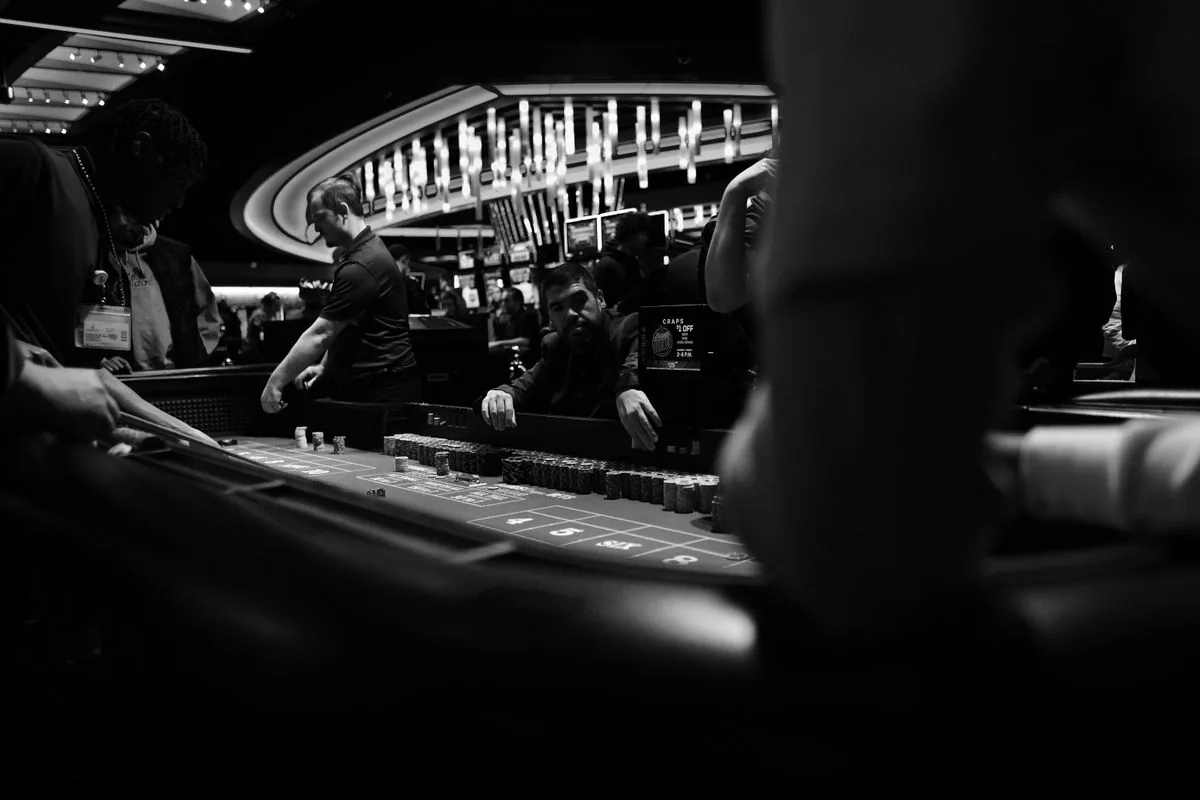
A craps table looks intimidating because of how much is printed on the felt, but the layout actually tells you something useful before you place a single chip: bets near the outer edge of the table tend to carry the lowest house edge, and bets clustered in the center tend to carry the highest. Learning what's on the felt and where isn't just about not looking lost at the table — it's a rough map of which bets are worth making.
How the table is actually divided
A standard craps table has three sections: two identical side sections at either end, mirror images of each other so players on both ends of the table can reach the same bets, and one center section running the full length of the table. The side sections hold the self-service bets players place themselves — Pass Line, Don't Pass, Come, Don't Come and Field — plus a row of numbered boxes (4, 5, 6, 8, 9, 10) for Place bets that the dealer sets for you. The center section is where the stickman manages proposition bets and hardways, wagers that settle on a single roll or a specific combination rather than a full round.
Don't Pass and Don't Come: betting against the shooter
The Pass Line bet, covered in craps basic strategy explained, wins with the shooter. Don't Pass is its mirror: you're betting the shooter sevens out before making the point, and it carries a house edge of roughly 1.36% — very slightly lower than the Pass Line's 1.41%, making it technically the best-priced standard bet on the table, though the social dynamic of betting against the table's shooter puts many players off it regardless of the math. Don't Come works the same way as Don't Pass but can be placed on any roll after the point is established, mirroring how a Come bet works for the pass-line side.
Come and Don't Come: a fresh pass-line bet mid-round
A Come bet is essentially a Pass Line bet you can make after the point is already set — the very next roll acts like a new come-out roll just for that bet: a 7 or 11 wins immediately, a 2, 3 or 12 loses immediately, and any other number becomes that bet's own personal point, tracked separately in the Come box until it resolves. This lets a player have multiple numbers working for them at once instead of only the table's shared point. Don't Come is the same mechanism flipped, betting against that fresh point the same way Don't Pass bets against the table's main point.
Field, hardways and proposition bets: where the edge gets worse
The Field bet is a single-roll bet covering 2, 3, 4, 9, 10, 11 and 12 — it looks generous because it covers seven numbers, but 5, 6, 7 and 8 are missing, and those are statistically the most likely rolls, which is why the Field carries a house edge typically around 2.7-5.5% depending on the specific payout table a casino uses for 2 and 12. Hardways bets, sitting in the center of the table, wager that a specific even number (4, 6, 8 or 10) rolls as a matched pair — a "hard 8" (4-4) instead of an "easy 8" (6-2 or 5-3) — before either a 7 or an easy version of that number shows, carrying house edges in the 9-11% range. Proposition bets like Any 7 or Yo (a roll of 11) settle on a single roll and sit deepest in the center, with house edges that regularly exceed 10% — the worst value on the entire layout, despite being visually the most eye-catching part of the table.
FAQ
- What are the three sections of a craps table? Two mirrored side sections at each end, holding self-service bets like Pass Line, Don't Pass, Come, Don't Come and Field plus the numbered Place bet boxes, and one center section running the length of the table where the stickman manages proposition bets and hardways.
- Is Don't Pass a better bet than Pass Line? Marginally, on the math alone — Don't Pass carries a house edge of roughly 1.36% versus the Pass Line's 1.41%, making it technically the lowest-edge standard bet on the table. Both are close enough that the real difference comes down to whether a player wants to bet with or against the shooter.
- Why is the Field bet not as good as it looks? The Field covers seven numbers (2, 3, 4, 9, 10, 11, 12), which looks like generous coverage, but it excludes 5, 6, 7 and 8 — the numbers most likely to be rolled — which is why its house edge typically runs around 2.7-5.5% rather than being genuinely favorable.
Related guides
- Craps basic strategy explained
- House edge explained
- Blackjack basic strategy explained
- Roulette european vs american explained